I’m currently engaged in a new Collaborative Exploration offered up the the Critical and Creative Thinking Community out of UMass Boston entitled “Young People Designing Their Own Lives.” The case challenges explorers to think about how we might go about helping young people tackle their life design challenges by presenting the concept for a script or book that would guide young folks as they chart their course.
Interestingly, this coincided with a conference session at the National Humanities Conference this past weekend. Folks from the PA Humanities Council talked about their Teen Reading Lounge program. The program has teens read books, discuss them, and then do hands on activities related to the books. The presenter linked the program and the exploration of literature to these key life questions teens are confronting:
- Who am I?
- What is my place in the world?
- What do I believe?
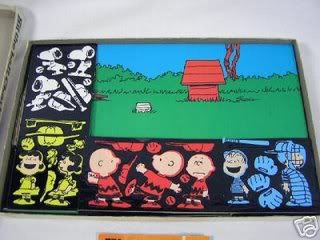
Definitely, important prompts to start a life journey. As I’ve been contemplating this case, I have also been thinking about creative books and activities from my youth. One of the things I loved most when I was young were Colorfoms. I loved having scenes where I could place characters and props. I could rearrange and reconfigure infinitely. I was free to orient, overlap, and edit. At the same time, I had a container or structure that bounded my exploration.
About a year ago, a few of my favorite pre-teens were interested in creating their own “tv show.” I gave them some simple guidelines:
- they each needed to have a character and know what their character was about and how that character related to the other characters
- they needed to have at least 3 settings
- they needed a challenge, task, or mission that they were trying to accomplish
- they could each bring or include one friend in the process
The girls scripted out a basic story line. They knew what each scene was and what they were trying to do. I told them to come to the tv studio ready to act. They should bring any costumes or props that they needed. I then let them design and arrange the various studio sets and furniture how they wanted. I showed them how the green screne worked so they could see the possibilities for creative backgrounds. From these basic elements they created and orchestrated a pretty silly, but cohesive story that was generated out of their own creative mind. It was sort of like Colorform media.
So, as I’m exploring and thinking on this month’s collaborative exploration, I’m contemplating how to go about crafting a basic environment with enough raw materials that might jumpstart the life design mindset of teens. What would this look like? What format — book, script, media production, game? What elements need to be in the mix and what will allow them to productively craft this? What supports or guidance are needed? It is exciting to think about.
]]>
We think of creativity as an individual quality. Incubated and expressed by a singular brain making sense of the world. And certainly there is an understanding that creative individuals can band together and form a community for mutual support and exploration of creative impulses. But what if creativity only exists because there is community? Because there are thoughts, ideas and connections to make sense of?
So this is the line of inquiry I started as part of the UMass Boston Critical and Creative Thinking’s current Collaborative Exploration -Everybody Can Think Creatively!! I came across Rhode’s (1961) concepts of the four Ps in the creative journey (Person, Process, Product, Press) which works from that idea that creativity is part of individual cognitive processes. But Glaveanu’s 2012 article entitled “Rewriting the Language of Creativity” argues for a sociocultural approach to these concepts transforming them into ones that have more social meaning. Person becomes Actor, Process becomes Action, Product translates to Artifact, and Press splits into its social meaning of Audience and its material component, Affordances. Here is how Glaveanu details the relationship between Rhodes “sociocognitive” approach and this more “sociocultural” one:
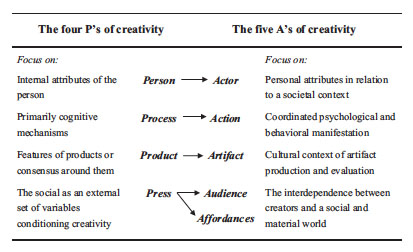
Glaveanu also provides a visual of how these 5As integrate with one another:
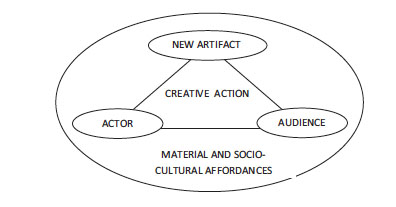
As someone who is more of a sociologist than a psychologist, Glaveanu’s 5As resonate with me at a deeper level. What if it is our ability to come to a situation and then the interactions of that situation that embody creative processes? What if it is not the product itself, but the meaning we attach to the product, its function as an artifact, that is the more important aspect of goods and ideas? And can any idea or creative endeavor exist outside of its social context, those who interact with it and the material constraints that birth it into being?
So how do these ideas and questions connect into the activities and concepts being explored in the #CICMOOC? The concept of being an actor or having agency is my next line of thinking and it seems to me that the lectures and exercises presented in these first two weeks by the University of Pennsylvania team are all about individuals viewing themselves as creative agents. By encouraging hands on experimentation and self reflection the materials invite and prompt us to think and act as creators. They provide multiple doorways into the act of creation and this week we gets some actual tools to get us going.
These three things – 1) an invitation and openness to create; 2) permission and encouragement to start with what you have and enter into the process with what you are and 3) support and materials to get you going seem critical to becoming and agent and feeling empowered to be creative. I still have much more to think about in relation to this creative agency concept, but I am at the start of this inquiry.
Referenced Articles:
Gl?veanu, V. P. (2013). Rewriting the language of creativity: The Five A’s framework. Review of General Psychology, 17(1), 69.
Rhodes, M. (1961). An analysis of creativity. The Phi Delta Kappan, 42(7), 305-310.
]]>a) expose a variety of possibly competing views of “Creative,” “Transformative,” and their combination;
I began here by searching for “transformative research” since any doctoral program would need to make the case on what new knowledge and research would it be preparing its students for. The National Science Foundation put out a report in 2007 (https://www.nsf.gov/nsb/documents/2007/tr_report.pdf) calling for the NSF to fund and support more “transformative reserach”. In the context of the report concepts of “risk,” “innovation,” and increasing openness to paradigm shifts. The NSF defines “transformative resaerch” as:
research driven by ideas that have the potential to radically change our understanding of an important existing scientific or engineering concept or leading to the creation of a new paradigm or field of science or engineering. Such research is also characterized by its challenge to current understanding or its pathway to new frontiers.
In particular the report looks at the resistance to change that comes from long standing institutional and cultural practices in the field of scientific research.:
Experts in the areas being challenged (many of whom may sit on review panels) may dismiss such ideas by pronouncing the research overreaching or without basis. Consequently, such ideas can remain hidden or discouraged and their breakthrough discoveries delayed or even missed. (p. 4)
I was also able to locate a call for transformative research in the social sciences (http://www.esrc.ac.uk/funding-and-guidance/funding-opportunities/23831/transforming-social-science.aspx) put out by the Economic and Social Research Council which is the largest funding agent in the UK for research in the economic and social issue arena. Issued for the 2012-2013 funding cycle, it is a relatively new push with a focus on “innovation” and “risk” as well.
We regard transformative research as that which involves pioneering theoretical and methodological innovation. The expectation is that the transformative research call will encourage novel developments of social science inquiry, and support research activity that attracts an element of risk.( p.1)
Some of the possible characteristics of transformative research according to this call include (p. 2):
- results that will radically change accepted thinking in the social sciences
- research that may be high risk but with the possibility of high reward
- research that is carried out with the expectation that it will produce a broad base of
- knowledge and new thinking/insights
The next line of inquiry in this area would be to look at concepts of “creative research” and transformative research in the context of the educational field.
b) draw employment possibilities from their own location in the world;
Thinking on who might be the potential audiences for a doctoral program in creative and transformational learning it occurs to me that these might be possible candidates:
- Those working in fluid and changing contexts
- Organizational leaders with diverse staff and customers / constituents
- Those at the intersection of sectors, fields or disciplines
- Individuals responsible for managing complex problems with diverse stakeholders
- Those in transnational / global environments
- Those seeking new ways to research and explore areas in new ways
I was then thinking about programs that are out there and have “non-traditional” or alternative concepts of graduate education with the idea that they might trigger ideas for promotion and language. The European Graduate School’s Expressive Arts PhD and Goddard’s MFA in Interdisciplinary Arts were two examples I was starting to explore along this thread.
The next step in this line of inquiry is find some additional examples and try to synthesize their approaches.
c) do blue-sky thinking about what kind of mid-career or mid-life creative and transformative education that would attract their personal interest
Thinking about the kind of program I would attract me, I jotted down these elements.
- A program that would ideally attract an extremely diverse set of students with varied experiences, research interests, and personal backgrounds
- Provides many, many opportunities for these students to interact and learn from one another — a learning community — Peter Taylor has been exploring the idea of a studio and in a previous collaborative exploration Marius Foley talked about elements of a co-constructive design environment. here Peter’s Studio idea, Marius’s criteria above
- Demonstration or mastery would take multiple forms an not just a written thesus (need to find examples)
- A small set of required core courses that focus on inquiry, research, engagement etc — similar to 3 core research and engagement courses in CCT program — 1 initial course designed to allow students to identify their core interests and begin a learning map of additional courses that will meet their goals.
- How can you design a program that seeks creativity and transformation without being too prescriptive?
I am going to continue thinking on what I would desire. I also started an inquiry in the term “doctorate”
- The term doctorate comes from the Latin docere, meaning “to teach.”
- At the university, doctoral training was a form of apprenticeship to a guild.
Resources
I’ve also collected these resources to follow up on mostly prompted by Dan’s paper on practice-based research.
- Hanson, Phil and Baron Bruce 2009. Research-Based Practice: Situating Vertical City between Artistic Development and Applied Cognitive Science. TDR/The Drama Review, Winter 2009, Vol. 53, No. 4 , Pages 120-136 (doi: 10.1162/dram.2009.53.4.120)
-
Leary, Mark R. 2001. Introduction to Behavioral Research Methodology. 3rd ed. Boston: Allyn and Bacon.
-
PARIP. n.d. Practice as Research in Performance. University of Bristol, www.bristol.ac.uk/parip/ (5 September 2008).
- Art & Research – http://www.artandresearch.org.uk/v2n2/busch.html
Borgdorff‘s vision of artistic research
]]>Embedded in artistic and academic contexts, artistic research seeks to convey and communicate content that is enclosed in aesthetic experiences, enacted in creative practices and embodied in artistic products.
Take a moment to check them out at http://www.119gallery.org and if you like what you see, either join us at our brunch on April 1st and / or contribute to our goals via Chipin – http://119gallery.chipin.com .
]]>Featured Member – Citizen Film
Founded in 2002 by Sophie Constantinou, Sam Ball and Kate Stilley Steiner, Citizen Film is an independent documentary production company dedicated to telling personal stories with care and dignity. We work with community institutions to make and distribute films that foster active participation in civic and cultural life. Citizen Film’s directors have also provided intensive film training at a variety of educational and community institutions throughout the San Francisco Bay Area.

Here is the piece Milo submitted to the 100 second festival. He really wanted folks to see his great work. Folks really laughed at the screening last evening at the Revolving Museum.
]]>Any how, here’s the piece I wrote:
December 3, 2003
Dear Landlord:
I hate to be such a pain, but could you kindly look into the small electrical problem in our kitchen. It seems that last night the outlet we had the toaster oven plugged into started to get quite hot and glow red. The result was a small fire that seems to have created some slight damage to the space. The firemen were quite positive in their attitude that we were all very lucky to have survived the incident. If you could look at it, weâ€ d appreciate it since the hole in the side of the house is creating quite a draft and the snow continues to pile up on the floor.
I know this comes right on the heels of our problem with the upstairs bathroom. Youâ€ll be pleased to know that the fire has taken care of the collapsed pantry that resulted from the bathtub dropping onto it.
We appreciate greatly your attempts to solve many of these problems yourself and understand that you are a busy man. While I know it may cause considerable expense, do you think you could hire someone to come quickly and resolve this current round of headaches? I ask since it has been about four months since the hole going from our apartment to the unit downstairs is still waiting for you to free up some time. I fear with this and the other problems, you may not be able to fit us into your workload.
I thank you for your time and attention to our concerns.
Sincerely,
Belinda Pelton
533 Warren Street – Apt. 4
Lowell, MA 01852
p.s. We have finally rid ourselves of the mouse colony that was camped out in the rear bedroom. Your advice to have your nephew, Nate, come with his pit bull was a brilliant solution.
]]>OK so this is no where close to the fame my name-twin, Felicia C. Sullivan , a noted writer in NYC, has. Renovation Journal is local and I’m sure there were only about a dozen folks who submitted. But hey, I get to put it on my resume and I get $100. Not bad for something that took about 15 minutes to write.
I think the letter will be published in the Spring 2006 issue of Renovation Journal and there will be a party on May 20th @ the Revolving Museum here in Lowell.
]]>