We think of creativity as an individual quality. Incubated and expressed by a singular brain making sense of the world. And certainly there is an understanding that creative individuals can band together and form a community for mutual support and exploration of creative impulses. But what if creativity only exists because there is community? Because there are thoughts, ideas and connections to make sense of?
So this is the line of inquiry I started as part of the UMass Boston Critical and Creative Thinking’s current Collaborative Exploration -Everybody Can Think Creatively!! I came across Rhode’s (1961) concepts of the four Ps in the creative journey (Person, Process, Product, Press) which works from that idea that creativity is part of individual cognitive processes. But Glaveanu’s 2012 article entitled “Rewriting the Language of Creativity” argues for a sociocultural approach to these concepts transforming them into ones that have more social meaning. Person becomes Actor, Process becomes Action, Product translates to Artifact, and Press splits into its social meaning of Audience and its material component, Affordances. Here is how Glaveanu details the relationship between Rhodes “sociocognitive” approach and this more “sociocultural” one:
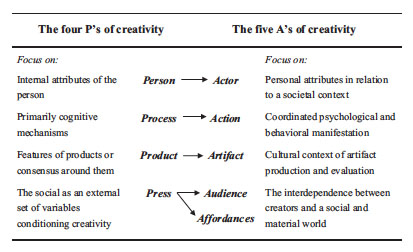
Glaveanu also provides a visual of how these 5As integrate with one another:
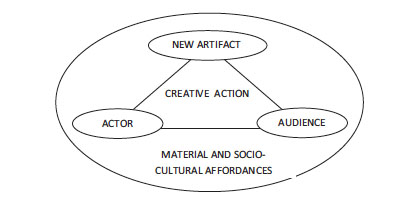
As someone who is more of a sociologist than a psychologist, Glaveanu’s 5As resonate with me at a deeper level. What if it is our ability to come to a situation and then the interactions of that situation that embody creative processes? What if it is not the product itself, but the meaning we attach to the product, its function as an artifact, that is the more important aspect of goods and ideas? And can any idea or creative endeavor exist outside of its social context, those who interact with it and the material constraints that birth it into being?
So how do these ideas and questions connect into the activities and concepts being explored in the #CICMOOC? The concept of being an actor or having agency is my next line of thinking and it seems to me that the lectures and exercises presented in these first two weeks by the University of Pennsylvania team are all about individuals viewing themselves as creative agents. By encouraging hands on experimentation and self reflection the materials invite and prompt us to think and act as creators. They provide multiple doorways into the act of creation and this week we gets some actual tools to get us going.
These three things – 1) an invitation and openness to create; 2) permission and encouragement to start with what you have and enter into the process with what you are and 3) support and materials to get you going seem critical to becoming and agent and feeling empowered to be creative. I still have much more to think about in relation to this creative agency concept, but I am at the start of this inquiry.
Referenced Articles:
Gl?veanu, V. P. (2013). Rewriting the language of creativity: The Five A’s framework. Review of General Psychology, 17(1), 69.
Rhodes, M. (1961). An analysis of creativity. The Phi Delta Kappan, 42(7), 305-310.
]]>Reflecting on self in CIC was a relatively deep endeavor designed to unearth my creative style, my motivations, my driving forces, influencing factors and thinking about blocks and supports. Connecting with others in this context is a secondary activity and a community of learners is still in the early stages of emerging. The injection of a quadblog group headed up by Cathleen Nardi helps with the idea that I’m at least accountable and connected to others who are sharing this experience. That I am part of a learning community. The return of familiar names and faces from the previous #edcmooc is also connective. So, here in CIC-land I’ve had time to consider material and think on self and move slowly into “conversation” with others. Although the conversation is right now more like a bunch of random broadcasts waiting for response.
The CE starts from a different place. The content is less prescribed and as such the starting place is a little more unsettled. I’m very familiar with this format now — I have my sea legs so to speak. While a small group has formed around a loose case or idea, the first step here is to really get to know each other. Intensive autobiographical introductions are the mechanism for doing this along with thinking about where each of us connects to the others. These connections are collectively shared.
So these are two very different places to start in thinking through creativity and creative process — structured content and a loose community vs. loose content and a structured community. It will be interesting to see how my thinking and knowledge builds through these two distinct learning experiences.
]]>
Reminded me of this piece in the Boston Globe a week and half ago written by local artist Donna Dodson – http://www.boston.com/business/blogs/global-business-hub/2012/04/art_as_commodit.html as well as the piece in Slate a couple of days ago about walkability – http://www.slate.com/blogs/moneybox/2012/04/17/_.html. Lowell is highlighted in both.
Making me wonder what are the other experiences and interactions that make Lowell a place? Also, I have had the feeling over the last couple of months that there is a swelling of engagement and activity happening especially with a group of younger leaders being visible — it is as though we are on the verge of a tipping point.
]]>
]]>The purpose of LaborTech is to bring together labor video, computer and media activists in the US and from around the world to build and develop labor communication technology and media. The first conference was held in 1990 and they have been held throughout the United States as well as Canada and Russia. Labor Media conferences are also held in Seoul. We believe that a critical task for labor is building a labor communication media movement that can tell our stories and break the corporate information blockade in every corner of the world.
http://web.media.mit.edu/~leob/thesis/
Despite the recent advances in science and technology, never in history has
the world seen so much discrepancy in wealth, power and living conditions.
Believing that information and communication technologies can help address
this issue, governments and funding organizations have been investing in
bringing computers and internet connectivity to underserved communities.
Unfortunately, many of those initiatives end up privileging the community
residents who were the most visible, literate or active, leaving behind the
ones who would need additional support and reinforcing even more the status
quo.
In order to foster a more democratic and participatory society, it is
important to create initiatives that are more inclusive and empower
individuals to control their own development. In this thesis, I propose a
framework for the design and analysis of technological initiatives for
social empowerment and I apply the framework in the implementation of two
initiatives that focus primarily on youth participation and local civic
engagement.
In the Young Activists Network initiative, I worked with youth technology
centers from different parts of the world organizing young people to become
agents of change in the places where they live. After two years trying
different ideas, it became clear that, in spite of the localized successes,
the Young Activists Network approach required so much effort from our
partner community organizations and volunteers that it would be virtually
impossible to sustain it over time and scale it to other sites.
Based on the lessons learned, I started the What’s Up Lawrence project, an
initiative that aimed at building a self-reinforcing, city-wide network to
help young people in the organization of personally meaningful community
events. In order to support such a network, I built What’s Up, a
neighborhood news system that combines the power of the telephone and of the
web to make it easier for young people to share information, promote
community events, and find out what is happening in their region.
This thesis provides a detailed description of the process that led to What’s
Up. It also highlights the main technical, educational and organizational
elements that have to be considered in the implementation of technological
initiatives for social empowerment and suggests the creation of a special
organization to help in the adoption and further refinement of the proposed
initiatives.
 So I’ve been sitting here watching the Oscars over the last almostthree hours – so some thoughts. The host, Ellen Degeneris, is setting atone that is casual and low-key. Environmentalism is highlighted. -the live event seems infused with diversity. There have been manylanguages, countries, races, and lifestyles portrayed by the livepeople and the films themselves. There are lots of behind the scenesactiom and the underpinnings of filmmaking. I have this feeling thatwe are being pulled in as important elements of the event. Thebroadcast makes me think that maybe as a culture Americans are on theverge of finally expanding and growing into the global communities weare part of it. It’s been a hopeful and comforting night. Something Iwouldn’t have expected at all.
]]>
For more about it checkout: Snippet TV | PEGSpace
http://communitymediareview.org/archive/2005/number_4/articles/section_1/sullivan
And while you’re at it check out the other articles in the publication.
]]>I do know this:
- communication is essential to communities, a community unable to communicate its values, ideals, and needs will find it difficult to grow or compete
- the tools and systems of modern communication have never been more accessible, but so many still are without access to or the skill in using these new tools
- corporations and governments are rapidly changing how we organize society, and if communities don’t advocate for the public sector we will loose a core ingredient for a true democracy
- I want to be one of those working to make sure that all of this happens and I want to work with other committed souls who have this as their mission
And so I found this:
Developing and communicating vision from the Community Toolbox.
]]>