Clearly the students in Parkland learned citizen lessons. Many of them say they learned these lessons in school. The civil rights leaders of the 50s and 60s learned these lessons in churches and communities. The Dreamers’ citizen lessons have emerged through lived experience and solidarity with each other. What does it mean to create educational spaces that educate for civic and collective outcomes? One guide I am revisiting was a set of 10 civic capabilities that I worked on with my former colleagues at CIRCLE. The genesis came from Amartya Sen and later Martha Nussbaum. I still think striving to build and create space for these capabilities in young people, us all really, is essential. All youth should have these essential civic capabilities:
- Voice: Being able to form, express, and reflect on diverse views on social issues.
- Hope and aspiration: Being able to conceive of a better society.
- Practical reason: “Being able to form a conception of the good and to engage in critical reflection about the planning of one’s life. (This entails protection for the liberty of conscience and religious observance.)” (From Nussbaum 2011, p. 34.)
- Civic relationships: Being able to form relationships marked by a degree of respect, loyalty, and trust.
- Affiliation: Being able to join or organize new groups around collective interests, including both groups that reflect particular interests and perspectives as well as groups that bring together a diversity of people.
- Collective decision-making: Being able to participate effectively and responsibly in inclusive group processes that lead to decisions.
- Work: Being able to create, form, and construct concrete objects of public value (physical objects or ideas, policies, etc.).
- Action: Being able to act individually and collectively in the public sphere.
- Value: Being able to see added value in the world around you from your own work, voice, or membership.
- Locus of control: Being able to have fundamental choice, agency, freedom, and mobility regarding decisions that govern one’s life, and being able to access education and work on an equal basis with others in order to exercise practical reason and enter into
We think of creativity as an individual quality. Incubated and expressed by a singular brain making sense of the world. And certainly there is an understanding that creative individuals can band together and form a community for mutual support and exploration of creative impulses. But what if creativity only exists because there is community? Because there are thoughts, ideas and connections to make sense of?
So this is the line of inquiry I started as part of the UMass Boston Critical and Creative Thinking’s current Collaborative Exploration -Everybody Can Think Creatively!! I came across Rhode’s (1961) concepts of the four Ps in the creative journey (Person, Process, Product, Press) which works from that idea that creativity is part of individual cognitive processes. But Glaveanu’s 2012 article entitled “Rewriting the Language of Creativity” argues for a sociocultural approach to these concepts transforming them into ones that have more social meaning. Person becomes Actor, Process becomes Action, Product translates to Artifact, and Press splits into its social meaning of Audience and its material component, Affordances. Here is how Glaveanu details the relationship between Rhodes “sociocognitive” approach and this more “sociocultural” one:
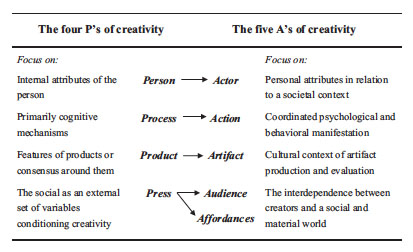
Glaveanu also provides a visual of how these 5As integrate with one another:
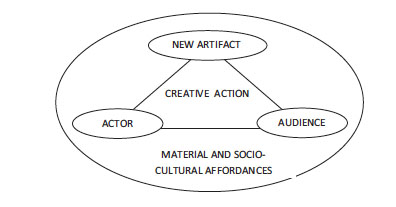
As someone who is more of a sociologist than a psychologist, Glaveanu’s 5As resonate with me at a deeper level. What if it is our ability to come to a situation and then the interactions of that situation that embody creative processes? What if it is not the product itself, but the meaning we attach to the product, its function as an artifact, that is the more important aspect of goods and ideas? And can any idea or creative endeavor exist outside of its social context, those who interact with it and the material constraints that birth it into being?
So how do these ideas and questions connect into the activities and concepts being explored in the #CICMOOC? The concept of being an actor or having agency is my next line of thinking and it seems to me that the lectures and exercises presented in these first two weeks by the University of Pennsylvania team are all about individuals viewing themselves as creative agents. By encouraging hands on experimentation and self reflection the materials invite and prompt us to think and act as creators. They provide multiple doorways into the act of creation and this week we gets some actual tools to get us going.
These three things – 1) an invitation and openness to create; 2) permission and encouragement to start with what you have and enter into the process with what you are and 3) support and materials to get you going seem critical to becoming and agent and feeling empowered to be creative. I still have much more to think about in relation to this creative agency concept, but I am at the start of this inquiry.
Referenced Articles:
Gl?veanu, V. P. (2013). Rewriting the language of creativity: The Five A’s framework. Review of General Psychology, 17(1), 69.
Rhodes, M. (1961). An analysis of creativity. The Phi Delta Kappan, 42(7), 305-310.
]]>For me, one of the most valauable insights came from Susie Lindsay and how she defined the various ages of “television” (broadcast, cable, Internet) and their varying value priorities. I’ve misplaced my notebook for the time being and with it the specifics of what the values in each era are. But the key thought was the idea that current communication battles are reflective of these clash of values (i.e; universal access vs. innovation).
I have thought for a while that the variety of regulatory environments (which I would also include telephony and sattelite) each brought with it a separate set of business practices and public give backs that have been embedded in the ways companies, communities and indivdiuals have come to expect and experience their variety of communication services. Looking at these battles from a value perspective helped me in attaching language to thoughts I’ve had for some time. Thanks Susie.
]]> I just finished reading a really wonderful essay by Curtis White in the April issue of Harper’s Magazine. The essay looks at US traditions of religion and reason and places them both in contrast to Thoreau’s thoughts on humanness and spirituality. A culture of death created by money and a corporate society are countered by individual resistance and instence on a stance in opposition to society. I certainly am not doing it justice, but is definitely worth a read.
]]>
I just finished reading a really wonderful essay by Curtis White in the April issue of Harper’s Magazine. The essay looks at US traditions of religion and reason and places them both in contrast to Thoreau’s thoughts on humanness and spirituality. A culture of death created by money and a corporate society are countered by individual resistance and instence on a stance in opposition to society. I certainly am not doing it justice, but is definitely worth a read.
]]> I participated in a panel yesterday that was part of the Women, Action and Media conference at MIT. The panel focussed on “Increasing Media Coverage Womenâ€
 s Issues in the South. Danielle Martin and myself were asked to present community-based and new media approaches to address the issues of women in the global south. Daniell has a nice powerpoint on her website which covered her topic of new media.
It occured to me after the presentation that the power of blogs and the Web 2.0, is not in the ability to become mass messaging systems, but rather to facilitate and ease dialogue and conversation. The ability to bring more people into contact with one another and for ideas to flow more rapidly.
]]>