 I am about ready to start another Collaborative Exploration (CE) cycle as this week’s Creativity, Innovation and Change MOOCs (CICMOOC) considers “resistance.” The October CE will focus on stories and story-telling as mechanisms to scaffold creative learning. The interesting thing about the CICMOOC’s call to “listen to the resistance” is this compliments the practice of extending and developing thinking in the CE. This is a process by which others respond to your thinking and ideas with suggestions you may not have considered.
Stories and story-telling are one possible way in which thinking may be challenged. I know I have looked to stories — in the form of books, movies, the experiences of others — to help me resolve tensions and conflict. But I wonder if stories of resistance, tension, and conflict can in themselves be productive forces? Just as we need our supportive community to empathize and listen, we also need challenge, pushing and resisted to grow. I know this to be true from my own research in youth development settings.
As I ask a couple of friends to resist me in one of my goals, by rafting their negative narratives, I am interested to see if my attempt to dispute and craft an alternative narrative will allow me to create a more solid belief in my own ability to succeed. I guess I will see 
]]>
]]>
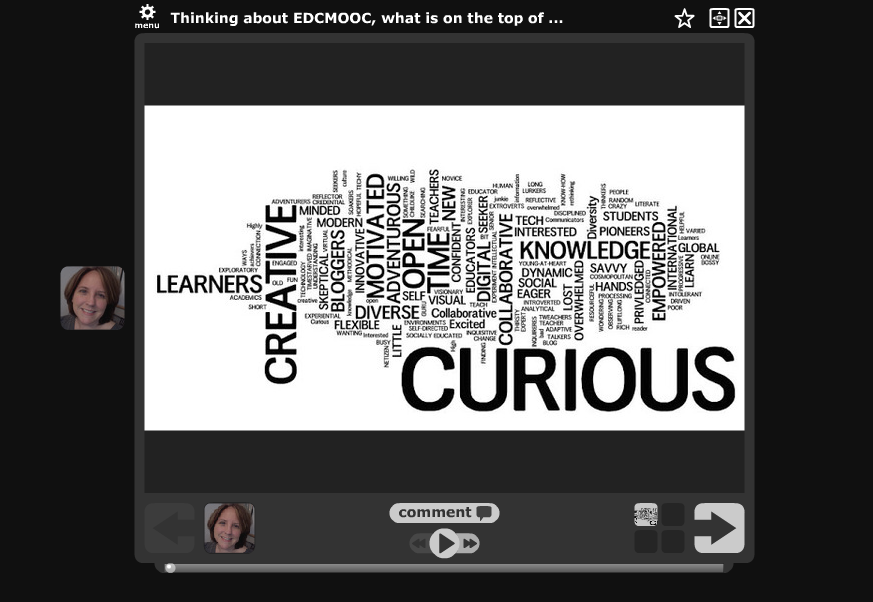
A couple of years ago I was looking for a way to bring a sense of embodied-ness to an online class where students simply couldn’t be together synchronously. The traditional discussion board was good, but had limits. So in seeking tools that might help with this snag, I came across VoiceThread. Since then, I’ve used this tool quite a lot to allow for project presentations and peer feedback. Students have loved it.
So, I thought I would test out the possibility of having an asynchronous, voice discussion with individuals participating in the e-Learning and Digital Cultures MOOC. Herre are the steps:
- Click on the image above and it will take you to the VoiceThread for this discussion.
- Hit play and listen to what has been contributed thus far to the discussion.
- If you want to add your own thoughts, press “comment” (you will have to sign in or register – sorry).
- Choose the “record” option and record your voiced contribution to the discussion.(try not to use “text” it defeats the embodied purpose and unfortunately I don’t have an account level that would accommodate video).
- Click “stop” and then “save.”
I am likely to provide some sort of synthesis of what folks share for those who don’t want to take the time to listen to the whole discussion (if one ends up happening). Mostly, I’m interested to see if folks have ideas on how else to created embodied presence asynchronously. I’m also interested to hear how others might use a tool like this as well.
UPDATE: The original VoiceThread for the eLearning and Digital Cultures now has over 50 voice comments and a small group has now progressed to scheduling a real-time Google Hangout. I am now drying to jumpstart a VoiceThread for the MIT Learning Creative Learning MOOC. That VoiceThread can be found here – http://bit.ly/YxC7ff.
]]>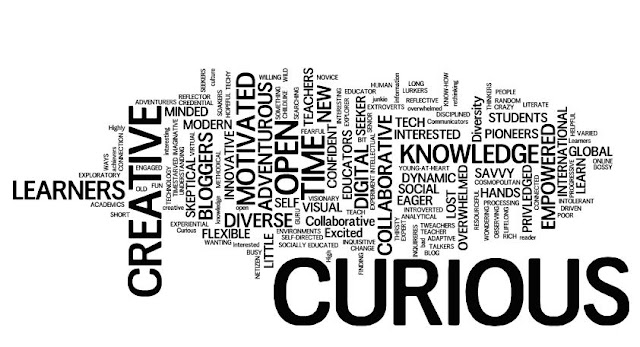
Word cloud courtesy of Letty Mills Barnes
So the various metaphors to replace the digital native / digital immigrant concepts got me thinking, “How do I think of the folks in this MOOC?” Then I started to think, “How do others think about them?” I know what some folks think, but are there more metaphors and adjectives out there?
At the same time, I’ve been working out concepts of sense-making within the context of a MOOC. Then I thought about a tool Peter Taylor in the Critical and Creative Thinking Program at UMass Boston uses a lot in his classes related to brainstorming and sense-making. So I decided to experiment with it for the #EDCMOOC.
So here is the process:
- Figure out a question or bit of information you’d like collective brainstorm on.
- Create an input form using Google Docs – There are lots of online tutorials on how to do this especially this one from Google Help. – My Example
- The form feeds into a Google Spreadsheet like this (image courtesy of Dick Vestdijk):

- If you want others to see the results you can share the spreadsheet by clicking on the share button and making sure that the “Public” option is chosen. You can make the spreadsheet “viewable’ or “editable”. I wanted folks to see what others had entered so they could do what they wanted with it.
- You can also share the results via the editing function of the form. One of the “More Actions” on this form is to “Edit the confirmation” and you can check off “Publish response summary”
- Once these form is created, promote via outlets. I posted to the EDCMOOC Twitter, Facebook, and Google+ communities. I shortened the Google link to the form using Bit.ly.
So the tool is actually quit simple. I think the more challenging part is thinking about the process of bringing the collective ideas and thoughts of so many into some useable form. Letty created the world cloud above, perhaps with a tool like Wordle. I’m going to try to do a conceptual sort to see if certain types of MOOCers appear. UPDATE: My first and second level sort can be found at this Google doc.
There is also a second attempt at this activity seeing what folks sharing their impression on “What is a MOOC?”.
So these are my questions:
- What would you do with this information on who are the MOOCers?
- How would you use a system / process like this?
You can use this tool to calculate an estimate of cost and return on investment for the recruitment and fundraising efforts of your staff in social networking sites like Facebook or MySpace. It works sort of like an online mortgage calculator. Just enter the starting assumptions in the yellow boxes below and the tool calculates results automatically.
Need some metrics guidelines? You might check out some of the online advocacy and fundraising benchmark studies. If you don’t measure results strictly by fundraising — maybe your results are based on advocacy or branding only — you can just look at the “cost per friend” or “cost per email name” to compare with the costs of recruiting people elsewhere. You can also see how that translates into cost per action or email viewed (opened).
If you would like to see the assumptions and equations behind the magical calculations, they are available on the original Excel spreadsheet. Email Justin Perkins to request a copy or to send feedback, and feel free to comment below.
]]>
]]>What can be done to aid researchers, advocates, and activists in producing, finding, and mobilizing relevant research and data? What can be done to facilitate the analysis of reform activities and strategies, and support the growth of broader conceptual frameworks and linkages between issues? What would a robust knowledge infrastructure for public-interest media look like?
“After reading Sobol and Waxman, I thought I would chime in. So far, I find this list incredibly useful to my own work and am really enjoying the discussions. That said, I continue thus….
First, utility is tautological. If you decide that human beings do things only for utility, then you will always find the utility in any action. Even suicide can be described as a utilitarian action.
Second, the authentic, and to my mind non-utilitarian, experience of life, has and always will be, beyond theft or co-optation by “the bad guys.” When I go to coffee with my friend and discuss Aristotle,money goes to those it perhaps shouldn’t (e.g. evil coffee bean slavers). Nonetheless, the substance of the experience belongs entirely to me and my friend.
My difficulty with the analysis so far in this thread is that I find it to be preoccupied with current online tools rather than abstract concepts. An alternate attempt might go something like this:
Suppose that every moment of your life were visible, capturable,collatable, analysable, (etc.) to others. Suppose that EVERY act in your life, that YOU tried to live authentically, was also being used for other purposes by someone else. How would you live? The answer, possibly paradox, is that you would ignore it, and in so doing you would live in such a way that anyone who was watching would be incapable of seeing your true life at all. They would only see your superficial movements, but all the while your inner movement would channel bliss.
The authentic life is ALWAYS a subversion, a resistance, a revolution, against some attempt by someone else to bind it, to bound it, to define it, to constrain it. To live authentically means to create in each moment something that cannot be taken and used for other purposes because it is necessarily INVISIBLE to those who would attempt such a theft.
Consequently, in my own academic work (i.e. logically), and also in my personal preference (i.e. aesthetically), I prefer to keep my eyes turned towards new forms of subversion, resistance, and revolution enable by new technologies. To my mind, the really interesting and revolutionary things going on in the world are invisible to those who would oppose themhttps://lists.thing.net/pipermail/idc/2007-August/002708.html
]]>“Trebor’s notions around immaterial labour certainly qualify here — collaborative media do obscure the free labour that goes into them. And also Wikis. Their collaborative veneer disguises the elitist participation in them.”
See Wikinomics discussion on iDC.
Also the discussion on the list about immaterial labor is very critcal as well. It starts in august 07 here:
https://lists.thing.net/pipermail/idc/2007-August/002691.html
]]>