 I am about ready to start another Collaborative Exploration (CE) cycle as this week’s Creativity, Innovation and Change MOOCs (CICMOOC) considers “resistance.” The October CE will focus on stories and story-telling as mechanisms to scaffold creative learning. The interesting thing about the CICMOOC’s call to “listen to the resistance” is this compliments the practice of extending and developing thinking in the CE. This is a process by which others respond to your thinking and ideas with suggestions you may not have considered.
Stories and story-telling are one possible way in which thinking may be challenged. I know I have looked to stories — in the form of books, movies, the experiences of others — to help me resolve tensions and conflict. But I wonder if stories of resistance, tension, and conflict can in themselves be productive forces? Just as we need our supportive community to empathize and listen, we also need challenge, pushing and resisted to grow. I know this to be true from my own research in youth development settings.
As I ask a couple of friends to resist me in one of my goals, by rafting their negative narratives, I am interested to see if my attempt to dispute and craft an alternative narrative will allow me to create a more solid belief in my own ability to succeed. I guess I will see 
]]>

So the material for this week’s Creativity, Innovation and Change MOOC is focusing on the idea of creative collaborations, In particular, the emphasis is on making the best use of a group’s wide range of talents, skills, capacities and motivations to move creative work forward and leaving the unproductive tensions to the side.
Bringing diverse perspectives and ideas to the table are also a core value in the Critical and Creativity Thinking program as well. As I was wrapping up participation in the September Collaborative Exploration: Everyone Can Think Creatively! I benefited a great deal from insights from two collaborators who gave me new ways to think about and extend my work at constructing an exercise that explored the social aspects of creation. Both of these individuals come to these CE with thinking that is different, yet both brought very good insights to my own thinking that I would not have come up with on my own. I love these experiences with CEs and other CCT offerings because there is an emphasis on promoting and sustaining spaces where lots of diverse ideas and thoughts can surface. I always learn something beyond what I thought I would.
This is also one of the aspects I love about the best of engagement in MOOCs — when I take advantage of it. The idea that I could come in contact with lots of diverse ideas and individuals is exhilarating. Yet, I seem to gravitate in these open learning environments to others who think about and are interested in the things I am — such as technology enabled learning, building learning communities, and navigating new learning landscapes. Here the contributions are not so much about an entirely new perspective, but rather going deeper and extending my thinking in an area shared by others.
So I wonder how we go about constructing our own personal learning networks to ensure that we have enough challenging people and opportunities that make us think differently, while at the same time cultivating connections with those who want to dig deep into an area we are all passionate about. Maybe this will be something to explore further in the upcoming open seminar on personal learning networks.
]]>
Keeley’s Blog: http://gatherwithpurpose.wordpress.com/
Rick’s Blog: http://drrbb2nd.blogspot.com/
Beth D.’s Blog: http://selfdirection.blogspot.com/
Fran’s Blog: https://elearningmoocedinburgh.wordpress.com/
Henry’s Blog – http://henryjburnett.
Virginia, I am sure, will in the not too distant future be publishing her thoughts on line as well.
]]>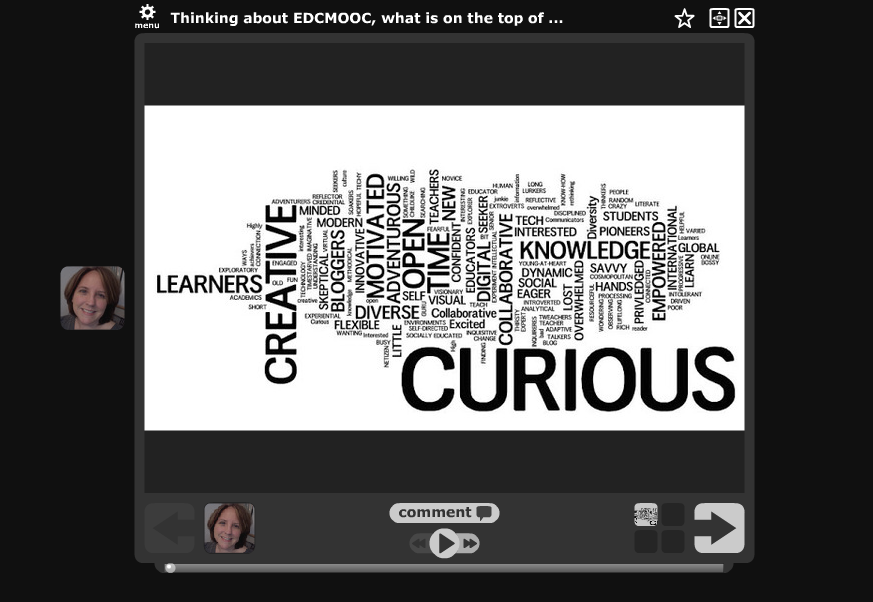
A couple of years ago I was looking for a way to bring a sense of embodied-ness to an online class where students simply couldn’t be together synchronously. The traditional discussion board was good, but had limits. So in seeking tools that might help with this snag, I came across VoiceThread. Since then, I’ve used this tool quite a lot to allow for project presentations and peer feedback. Students have loved it.
So, I thought I would test out the possibility of having an asynchronous, voice discussion with individuals participating in the e-Learning and Digital Cultures MOOC. Herre are the steps:
- Click on the image above and it will take you to the VoiceThread for this discussion.
- Hit play and listen to what has been contributed thus far to the discussion.
- If you want to add your own thoughts, press “comment” (you will have to sign in or register – sorry).
- Choose the “record” option and record your voiced contribution to the discussion.(try not to use “text” it defeats the embodied purpose and unfortunately I don’t have an account level that would accommodate video).
- Click “stop” and then “save.”
I am likely to provide some sort of synthesis of what folks share for those who don’t want to take the time to listen to the whole discussion (if one ends up happening). Mostly, I’m interested to see if folks have ideas on how else to created embodied presence asynchronously. I’m also interested to hear how others might use a tool like this as well.
UPDATE: The original VoiceThread for the eLearning and Digital Cultures now has over 50 voice comments and a small group has now progressed to scheduling a real-time Google Hangout. I am now drying to jumpstart a VoiceThread for the MIT Learning Creative Learning MOOC. That VoiceThread can be found here – http://bit.ly/YxC7ff.
]]>
Word cloud courtesy of Letty Mills Barnes
So the various metaphors to replace the digital native / digital immigrant concepts got me thinking, “How do I think of the folks in this MOOC?” Then I started to think, “How do others think about them?” I know what some folks think, but are there more metaphors and adjectives out there?
At the same time, I’ve been working out concepts of sense-making within the context of a MOOC. Then I thought about a tool Peter Taylor in the Critical and Creative Thinking Program at UMass Boston uses a lot in his classes related to brainstorming and sense-making. So I decided to experiment with it for the #EDCMOOC.
So here is the process:
- Figure out a question or bit of information you’d like collective brainstorm on.
- Create an input form using Google Docs – There are lots of online tutorials on how to do this especially this one from Google Help. – My Example
- The form feeds into a Google Spreadsheet like this (image courtesy of Dick Vestdijk):

- If you want others to see the results you can share the spreadsheet by clicking on the share button and making sure that the “Public” option is chosen. You can make the spreadsheet “viewable’ or “editable”. I wanted folks to see what others had entered so they could do what they wanted with it.
- You can also share the results via the editing function of the form. One of the “More Actions” on this form is to “Edit the confirmation” and you can check off “Publish response summary”
- Once these form is created, promote via outlets. I posted to the EDCMOOC Twitter, Facebook, and Google+ communities. I shortened the Google link to the form using Bit.ly.
So the tool is actually quit simple. I think the more challenging part is thinking about the process of bringing the collective ideas and thoughts of so many into some useable form. Letty created the world cloud above, perhaps with a tool like Wordle. I’m going to try to do a conceptual sort to see if certain types of MOOCers appear. UPDATE: My first and second level sort can be found at this Google doc.
There is also a second attempt at this activity seeing what folks sharing their impression on “What is a MOOC?”.
So these are my questions:
- What would you do with this information on who are the MOOCers?
- How would you use a system / process like this?
I took all of the text from the 44 responses and pasted that text into Wordle (http://www.wordle.net) which is a free tool to create word clouds. The only word I deleted from the text was “gallery” since it is used often in reference to the name of the space. Here is the resulting Wordle:
 So initially, I would say that this display of text data is a good first step to assessing raw word count content. In reading the responses it was clear that the sense of community was clearly present and given that the organization is an arts organization it is therefore not surprising that the 119 emerges as a “community art” space.
People, artists and Walter (one of the founders) emerge as other prominent words. The what of the space — work, shows, events, music are not surprising. The ideas of support, appreciation, welcoming are joined by open, creative, opportunity and unique which are in my opinion essential qualities of the organization. Other interesting words that emerge are things like sense, felt, believe, feel and experience.
What the quick and dirty doesn’t provide is more nuance and context to the words. Thus a traditional coding process can get at deeper meaning. But this initial test seems promising.
]]>You can use this tool to calculate an estimate of cost and return on investment for the recruitment and fundraising efforts of your staff in social networking sites like Facebook or MySpace. It works sort of like an online mortgage calculator. Just enter the starting assumptions in the yellow boxes below and the tool calculates results automatically.
Need some metrics guidelines? You might check out some of the online advocacy and fundraising benchmark studies. If you don’t measure results strictly by fundraising — maybe your results are based on advocacy or branding only — you can just look at the “cost per friend” or “cost per email name” to compare with the costs of recruiting people elsewhere. You can also see how that translates into cost per action or email viewed (opened).
If you would like to see the assumptions and equations behind the magical calculations, they are available on the original Excel spreadsheet. Email Justin Perkins to request a copy or to send feedback, and feel free to comment below.
]]>Both speakers provided great background and activity in the realm of communication’s policy and participants were enaged in disucssing some of the key point highlighted.
For me, one of the most valauable insights came from Susie Lindsay and how she defined the various ages of “television” (broadcast, cable, Internet) and their varying value priorities. I’ve misplaced my notebook for the time being and with it the specifics of what the values in each era are. But the key thought was the idea that current communication battles are reflective of these clash of values (i.e; universal access vs. innovation).
I have thought for a while that the variety of regulatory environments (which I would also include telephony and sattelite) each brought with it a separate set of business practices and public give backs that have been embedded in the ways companies, communities and indivdiuals have come to expect and experience their variety of communication services.
Looking at these battles from a value perspective helped me in attaching language to thoughts I’ve had for some time. Thanks Susie.
]]>I’ve just started experimenting with a rather funky tool called Talkr. Essentially, Talkr is a podcast generator for text blogs, and it has enormous implications for people with visual impairments and limited literacy.
When you look at a typical blog, it’s mostly text. This may be no problem for many people, but if you’re reading skills aren’t strong or you don’t see well, text blogs can be quite a challenge. Meanwhile, thousands of Internet users create their own podcasts, which are basically blogs containing audio files. Apart from being really cool for everyone, podcasts are particularly useful for people who can’t read or see well. But they’re not exactly practical for the hard of hearing, either, who would benefit more from reading a text blog. Theoretically, it would be great if every person who wrote a text blog would record a podcast of it as well, but very few, if any bloggers bother to do this.
Enter Talkr. Talkr is a Web-based speech synthesizer that takes the texts of blogs and generates and MP3 file, with a computer voice speaking the text. For people who just want to visit their favorite text blogs and listens to them, Talkr works as blog management tool; you simply add your favorite blogs to your account, and it will create a computer-generated voice mp3 for each entry. Meanwhile, for all of you bloggers out there, Talkr lets you embed a computer-generatd mp3 into each of your blog entries, and supplies you with an RSS feed for them. This means that users can either come to your blog and click a link to listen to the mp3, or they can use iTunes or another podcast management tool to subscribe to the feed and receive each new mp3 file automatically. [continued]
]]>