
So in considering the contours and definition of a “personal learning network” (PLN), I turned to the trusty online dictionary. So the words personal and learning seemed to garner definitions that resonated:
Personal — relating to, directed to, or intended for a particular person
Learning — the act or process of acquiring knowledge or skill
Then I came to network and that is when things started to get really fuzzy and exciting at all?the same time. So one possible definition revolves around the connective mechanisms: any combination of filaments, lines, veins, passages or the like in a netlike form
So here we have conduits, tissues and live wires formed into a specific pattern that is interlocking, decentralized, yet strong. Then there is this definition related to radio and television:
a group of transmitting stations linked by wire or microwave relay so that the same program can be broadcast or telecast by all
This idea of entities transmitting information and relaying it seems useful. The part about broadcasting “the same program” not so much. And then there is this:
a system of interrelated buildings, offices, stations, etc., especially over a large area or throughout a county, territory, region, etc.
This definition brings in the sense of geographic space and travel across that space. That seems cool. Then there is the idea of a network related to electricity:
an arrangement of conducting elements, as resistors, capacitors, or inductors connected by conducting wire.
In some ways this harkens to the first definition, but the inclusion of concepts like “resistors,” “capacitors,” “inductors” and by extension “transmitters,” “amplifiers,” “switches” and such start to flesh out the dynamic processes that are inherent in electrical grids — overloads, blackouts, excess capacity are also part of this analogy.
So, I’m sure if I search further there would be other networks with finer nuances depending on the sector or field — social networks, computer networks, underground networks.
So how do I make sense of network as a definition? These are the things that work for me:
decentralized, interlocking, formed by many materials to aid movement and conduction, spread out across space (and I’d say time as well) with dynamic components that work for and against its smooth operation.
So a personal learning network? So if we add this network definition to the personal and learning I would get:
spanning space and time, a personal learning network is a decentralized, interlocking, multi-material form with dynamic components that work for and against an individual’s process of acquiring knowledge and skills.
Any way, that’s what I have for the time being. I realize, that the “what” moving across this network is till not particularly clear with “components” being a particularly fuzzy concept. I’ll need to think on that. (#xplrpln)
]]>
So the material for this week’s Creativity, Innovation and Change MOOC is focusing on the idea of creative collaborations, In particular, the emphasis is on making the best use of a group’s wide range of talents, skills, capacities and motivations to move creative work forward and leaving the unproductive tensions to the side.
Bringing diverse perspectives and ideas to the table are also a core value in the Critical and Creativity Thinking program as well. As I was wrapping up participation in the September Collaborative Exploration: Everyone Can Think Creatively! I benefited a great deal from insights from two collaborators who gave me new ways to think about and extend my work at constructing an exercise that explored the social aspects of creation. Both of these individuals come to these CE with thinking that is different, yet both brought very good insights to my own thinking that I would not have come up with on my own. I love these experiences with CEs and other CCT offerings because there is an emphasis on promoting and sustaining spaces where lots of diverse ideas and thoughts can surface. I always learn something beyond what I thought I would.
This is also one of the aspects I love about the best of engagement in MOOCs — when I take advantage of it. The idea that I could come in contact with lots of diverse ideas and individuals is exhilarating. Yet, I seem to gravitate in these open learning environments to others who think about and are interested in the things I am — such as technology enabled learning, building learning communities, and navigating new learning landscapes. Here the contributions are not so much about an entirely new perspective, but rather going deeper and extending my thinking in an area shared by others.
So I wonder how we go about constructing our own personal learning networks to ensure that we have enough challenging people and opportunities that make us think differently, while at the same time cultivating connections with those who want to dig deep into an area we are all passionate about. Maybe this will be something to explore further in the upcoming open seminar on personal learning networks.
]]>

This week’s materials in the CICMOOC on the Paradox of Structure sparked that seed of interest for me. For the last couple of years I have been exploring the contours of self-organizing within open organizational structures (e.g. open source software movement, world social forum). The 119 Gallery in Lowell, MA is often the focus of this work and I’ve written about it at various place on this blog [post 1, post 2, post 3]. However, the prompt to explore structure in the CICMOOC as one of week 3’s exercises has me returning to the comparison between this MOOC and my current Collaborative Exploration (CE) offered up by the Critical and Creative Thinking Program at UMass Boston.
I’m trying to enlist the help of one or more of the current participants of the CE to collaborate with me in the CICMOOC exercise on the Paradox of Structure. In the meantime, I thought I would explore the enabling and limiting features of the two current learning spaces I find myself in at this time. Both learning spaces are looking at creativity and ways to engage and enliven individual creativity.
The CE is a 22 day small group, case-based exploration under the topic of “Everyone Can Think Creatively!”. Meeting synchronously once a week for an hour using Google+ Hangout and engaging in individual inquiries based on the case in between are the main activities. Each synchronous session has a format and structure, while the individual inquiries are diverse and broad. The group exchanges are intended to support and stretch individual thinking.
The UMass Boston CE enables me to pick my own path of inquiry, but within a defined structural space that focuses or contains the inquiry. Much like the story shared in the CICMOOC lecture this week by Kathryn Jablokow.. There are colleagues to motivate and be accountable to as well as provide additional thinking and support. It also helps me to know that this is a contained activity with defined parameters of time and input which helps me move forward. In terms of limits, the CE has a small number of individuals to engage with. The connections are deep, but not particularly diverse. Also even thought the time is specified, it still creates some pressure to maintain the schedule.
The UPenn CICMOOC on Coursera has a more formal 8-week course structure. It is a MOOC, so thousands of individuals might be engaging at any given time. The course has build in a great deal of diversity in terms of materials, levels of engagement and assignments. There are assignments, activities and projects to prompt accountability. I am also participating with a learner initiated quadblog initiated by Cathleen Nardi with myself, Maureen Maher and Jack Matson.
The CICMOOC is enabling in a very different way. Here the course materials are more prescribed, but they are provided in easy to access and digest formats with the option to dig deeper if I like. Likewise, weekly activities and exercises are diverse enough and there is enough freedom to choose those that interest me. I have thus far found at least one exercise that energizes me each week. The course’s three possible levels of engagement create both freedom and support. Each level is presented as completely valid and no option is presented as better than the other, just different.
In terms of limits, the CICMOOC has provided the opportunity to engage with a very broad set of learners and potentially ideas. I have yet to fully engage in deep exchanges. In part this is a lack of my own commitment to do so, but without accountability (or obligation) built in I am finding it difficult to make the time to engage. The exception to this is the self-organized quadblogging group. This commitment to quadblog has been enough to prompt me to write regularly and interact with a few folks. I see that part of the exercise for this week prompts a step to participate in the discussion board, so I will see what happens next. This inability to have others really respond, react and prompt further thinking prevents deep understanding and exploration of the content.
I am gong to continue to think on these formats and for the time being it seem to me that any eLearning ecosystem needs to have a diversity of options and levels of engagement with content and learners. Enabling others and supporting learners to build that ecosystem is what I hope an upcoming open seminar on Personal Learning Networkswill explore.
Image from: http://davincidilemma.com/2010/12/add-structure-to-your-schedule-to-be-more-creative/
]]>Reflecting on self in CIC was a relatively deep endeavor designed to unearth my creative style, my motivations, my driving forces, influencing factors and thinking about blocks and supports. Connecting with others in this context is a secondary activity and a community of learners is still in the early stages of emerging. The injection of a quadblog group headed up by Cathleen Nardi helps with the idea that I’m at least accountable and connected to others who are sharing this experience. That I am part of a learning community. The return of familiar names and faces from the previous #edcmooc is also connective. So, here in CIC-land I’ve had time to consider material and think on self and move slowly into “conversation” with others. Although the conversation is right now more like a bunch of random broadcasts waiting for response.
The CE starts from a different place. The content is less prescribed and as such the starting place is a little more unsettled. I’m very familiar with this format now — I have my sea legs so to speak. While a small group has formed around a loose case or idea, the first step here is to really get to know each other. Intensive autobiographical introductions are the mechanism for doing this along with thinking about where each of us connects to the others. These connections are collectively shared.
So these are two very different places to start in thinking through creativity and creative process — structured content and a loose community vs. loose content and a structured community. It will be interesting to see how my thinking and knowledge builds through these two distinct learning experiences.
]]>
- Cathleen Nardi http://cathleennardi.wordpress.com/
- Jack Matson http://innovateordieonline.com/
- Maureen Maher http://maureenmaherblog.wordpress.com/
What both quad-blogging and Collaborative Explorations have in common is that they attempt to create “thicker” connections within a learner community that is disperse and diffuse. Strategies such as these seem essential in creating one’s personal learning network (PLN) in the ever expanding world of MOOCs and other online learning venues. It will be interesting to see what these micro-community of learners yield and how the two formats differ.
]]>a) expose a variety of possibly competing views of “Creative,” “Transformative,” and their combination;
I began here by searching for “transformative research” since any doctoral program would need to make the case on what new knowledge and research would it be preparing its students for. The National Science Foundation put out a report in 2007 (https://www.nsf.gov/nsb/documents/2007/tr_report.pdf) calling for the NSF to fund and support more “transformative reserach”. In the context of the report concepts of “risk,” “innovation,” and increasing openness to paradigm shifts. The NSF defines “transformative resaerch” as:
research driven by ideas that have the potential to radically change our understanding of an important existing scientific or engineering concept or leading to the creation of a new paradigm or field of science or engineering. Such research is also characterized by its challenge to current understanding or its pathway to new frontiers.
In particular the report looks at the resistance to change that comes from long standing institutional and cultural practices in the field of scientific research.:
Experts in the areas being challenged (many of whom may sit on review panels) may dismiss such ideas by pronouncing the research overreaching or without basis. Consequently, such ideas can remain hidden or discouraged and their breakthrough discoveries delayed or even missed. (p. 4)
I was also able to locate a call for transformative research in the social sciences (http://www.esrc.ac.uk/funding-and-guidance/funding-opportunities/23831/transforming-social-science.aspx) put out by the Economic and Social Research Council which is the largest funding agent in the UK for research in the economic and social issue arena. Issued for the 2012-2013 funding cycle, it is a relatively new push with a focus on “innovation” and “risk” as well.
We regard transformative research as that which involves pioneering theoretical and methodological innovation. The expectation is that the transformative research call will encourage novel developments of social science inquiry, and support research activity that attracts an element of risk.( p.1)
Some of the possible characteristics of transformative research according to this call include (p. 2):
- results that will radically change accepted thinking in the social sciences
- research that may be high risk but with the possibility of high reward
- research that is carried out with the expectation that it will produce a broad base of
- knowledge and new thinking/insights
The next line of inquiry in this area would be to look at concepts of “creative research” and transformative research in the context of the educational field.
b) draw employment possibilities from their own location in the world;
Thinking on who might be the potential audiences for a doctoral program in creative and transformational learning it occurs to me that these might be possible candidates:
- Those working in fluid and changing contexts
- Organizational leaders with diverse staff and customers / constituents
- Those at the intersection of sectors, fields or disciplines
- Individuals responsible for managing complex problems with diverse stakeholders
- Those in transnational / global environments
- Those seeking new ways to research and explore areas in new ways
I was then thinking about programs that are out there and have “non-traditional” or alternative concepts of graduate education with the idea that they might trigger ideas for promotion and language. The European Graduate School’s Expressive Arts PhD and Goddard’s MFA in Interdisciplinary Arts were two examples I was starting to explore along this thread.
The next step in this line of inquiry is find some additional examples and try to synthesize their approaches.
c) do blue-sky thinking about what kind of mid-career or mid-life creative and transformative education that would attract their personal interest
Thinking about the kind of program I would attract me, I jotted down these elements.
- A program that would ideally attract an extremely diverse set of students with varied experiences, research interests, and personal backgrounds
- Provides many, many opportunities for these students to interact and learn from one another — a learning community — Peter Taylor has been exploring the idea of a studio and in a previous collaborative exploration Marius Foley talked about elements of a co-constructive design environment. here Peter’s Studio idea, Marius’s criteria above
- Demonstration or mastery would take multiple forms an not just a written thesus (need to find examples)
- A small set of required core courses that focus on inquiry, research, engagement etc — similar to 3 core research and engagement courses in CCT program — 1 initial course designed to allow students to identify their core interests and begin a learning map of additional courses that will meet their goals.
- How can you design a program that seeks creativity and transformation without being too prescriptive?
I am going to continue thinking on what I would desire. I also started an inquiry in the term “doctorate”
- The term doctorate comes from the Latin docere, meaning “to teach.”
- At the university, doctoral training was a form of apprenticeship to a guild.
Resources
I’ve also collected these resources to follow up on mostly prompted by Dan’s paper on practice-based research.
- Hanson, Phil and Baron Bruce 2009. Research-Based Practice: Situating Vertical City between Artistic Development and Applied Cognitive Science. TDR/The Drama Review, Winter 2009, Vol. 53, No. 4 , Pages 120-136 (doi: 10.1162/dram.2009.53.4.120)
-
Leary, Mark R. 2001. Introduction to Behavioral Research Methodology. 3rd ed. Boston: Allyn and Bacon.
-
PARIP. n.d. Practice as Research in Performance. University of Bristol, www.bristol.ac.uk/parip/ (5 September 2008).
- Art & Research – http://www.artandresearch.org.uk/v2n2/busch.html
Borgdorff‘s vision of artistic research
]]>Embedded in artistic and academic contexts, artistic research seeks to convey and communicate content that is enclosed in aesthetic experiences, enacted in creative practices and embodied in artistic products.
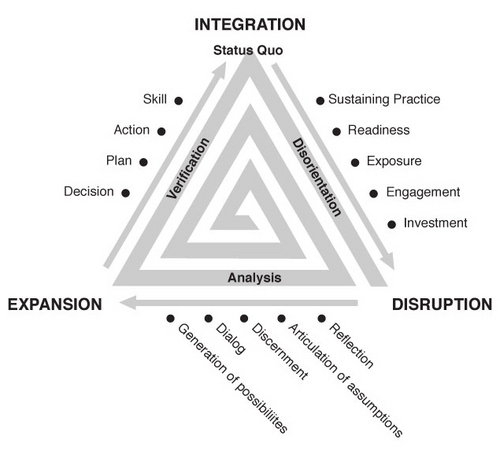
As part of a Creative Exploration (CE) on cMOOCs, Rhoda Mauer at Cornell has been posting comments and resources related to concepts of panic, trust and storytelling. At the same time, Peter Taylor, who is also part of the CE, is talking about a possible new collaboration on transformative education. These conversations intersect with my attempts to understand the power of shifting perspective and building confidence and competence (self-efficacy) that may result from being in a new or unique learning environment.
A brief Google search on the terms “disorientation learning trust” got me to a piece on transformative learning. So my exploration is turning to learning more about “transformative learning”.
In a Journal of Environmental Education piece, D’Amato and Krasny (2011) write:
Transformative learning is often precipitated by a “disorienting dilemma,” which is followed by critical self-re?ection, social interactions, planning for action, and building competence and self-con?dence in new roles and relationships as a result of taking action (Mezirow, 2000). Such learning could result in personal growth as well as in questioning and changing one’s behaviors toward the environment (instrumental learning). (p.239)
Kucukaydin and Cranton (Adult EducationQuarterly, 2013) also reference Mezirow as four distinct types of transformative learning:
- developmental (Daloz, 1999)
- emancipatory (Freire, 1972)
- extrarational (Boyd,1989)
- rational (Mezirow, 1991)
Keegan (Asian Social Science, 2011) also speaks to four processes in transformative learning (critical reflection or feedback, reflective discourse or evaluation, and action related to learning and teaching quality). that resonate with the 4 Rs and Probe-Create-Change-Reflect modes that Peter Taylor talks about as well as the experience I had during the EDCMOOC offered Coursera by U of Edinburgh.
Let’s see where this creative exploration path takes me.
]]>
]]>
For a couple of years I’ve been thinking about self-organizing systems as they apply to community-based organizations. Recently ideas such as connectivism and networked learning environments have entered into my thinking. So, I thought it might help for me to pull out the features of self-organizing projects and map them against the EDCMOOC.
| Feature | Description / Importance / Role |
| Plateaus / Frameworks / Boundaries | Organizing spaces or defined scope that shapes the problem space. Can be a physical, virtual or conceptual space or goal. Keeps the actors in a focused area.
The EDCMOOC did this through the construct of a class with defined content blocks and activities. The MOOC was the container for this system. |
| Heterogeneity / Differentiation | Variance in the systems of actors, ideas, roles. Too much similarity will not create the tension or conflict necessary to move the system forward.
The EDCMOOC provided multiple platforms for communication and engagement (e.g. Coursera forums, Google G+ community, Twitter, Facebook) and presented content in a broad and open enough manner to appeal to a variety of interests. By reaching a global community and engaging thousands of individuals there was more diversity than in a traditional class, although there were gaps or lack of certain perspectives (e.g. those without access, those in more disenfranchised settings, etc). |
| Ambiguity | Some amount of non-definition that leaves room for questions, exploration and introduction of new ideas or pathways that were not planned for or expected.
Content in the EDCMOOC was presented in thematic blocks. There were choices and avenues for exploration. The main assignment was intentionally vague to invite a myriad of interpretations. |
| Boundary Objects | A set of tools or concepts that are “plastic” enough to be bent and used by different actors in different ways, but still can act as a “glue” of sorts.
The EDCMOOC boundary objects were the electronic communications — emails, tweets, fb posts, blog entries and collection of additional creative tools that allowed for a range of expressions. |
| Connections / Mulit-level / Polycentric | Importance of many connections between actors both vertical and horizontal as well as multiple actions and centers of activity. Lends to robustness and resilience.
The EDCMOOC probably succeeded most in this arena. By de-centering the instructors, creating relatively open thematic blocks and proposing multiple communication blocks, the MOOC was able to allow for leaders and passionate users to emerge and connect across multiple platforms. Many of the participants mapped these interactions to demonstrate the broad network. |
| Feedback / Learning / Adaptation | The system should allow for new information and lessons learned to move throughout the system and adapt accordingly.
The EDCMOOC had enough structured interactions (e.g. Google Hangout, Twitter Chats, defined meeting spaces) that individuals interested in engaging could collective share and discuss. The open, self-directed nature of the environment also allowed for individuals to find new pathways and thinking on new resources in relation to the proposed themes and ongoing discussion of participatns. |
| Coordination / Influence / Control | Not a command and control style, but rather will maintain the system by which information gets integrated and moved throughout the system. May play a categorization or prioritization role or facilitate such processes happening.
Clearly the instructional team for the EDCMOOC at the University of Edinburgh played a critical role in defining the the content, orchestrating the release of that content, and providing top level information and communication. Addiitonally, multiple node of coordination emerged throughout from participants themselves from the core group who created resources prior to the start of class, to organizers of the Twitter chats, to folks like Keeley who scheduled real-time gatherings and interactions. |

As I’m exploring the contours and shape of MOOCs through the eLearning and Digital Cultures MOOC, I am confronted by a whole set of acronyms — xMOOC, cMOOC, mobiMOOC, moocl, SOOC, modMOOC. At the same time I’m thinking through the critiques of MOOC including who they do and don’t serve or what is an isn’t possible within these environments.
Like many things, early movers in new technology realms, like Coursera and Udacity, which also have the ability to leverage resources — human, financial, technical — get to define and build the landscape. They become our de facto understanding of what a MOOC is or what is possible in the framing of “open education.”
Yet there are other models possible and other endeavors underway. Peer-2-Peer University allows anyone to create a course while providing a portal for reaching larger audiences than any individual effort could on their own. The Online University of the Left askew the capital market place rationale of the early movers. The University of the People tries to combine online learning but modeling ways to increase access and prevent cost from being a barrier. Mobile technologies, which more individuals globally have access to, are also being leveraged for MOOC-type learning with a development bent.
Now there will be those who say these are not MOOCs, but they definitely are in the OOC vien. Do we even know all o the multiple ways in which content on those platforms we identify with MOOCs are used? It seems that we need all the models we can get. Experimentation, innovation, working things out. Surely some will fail which is far preferable to having one set idea of what it is to expand learning online in the vien of open education.
]]>